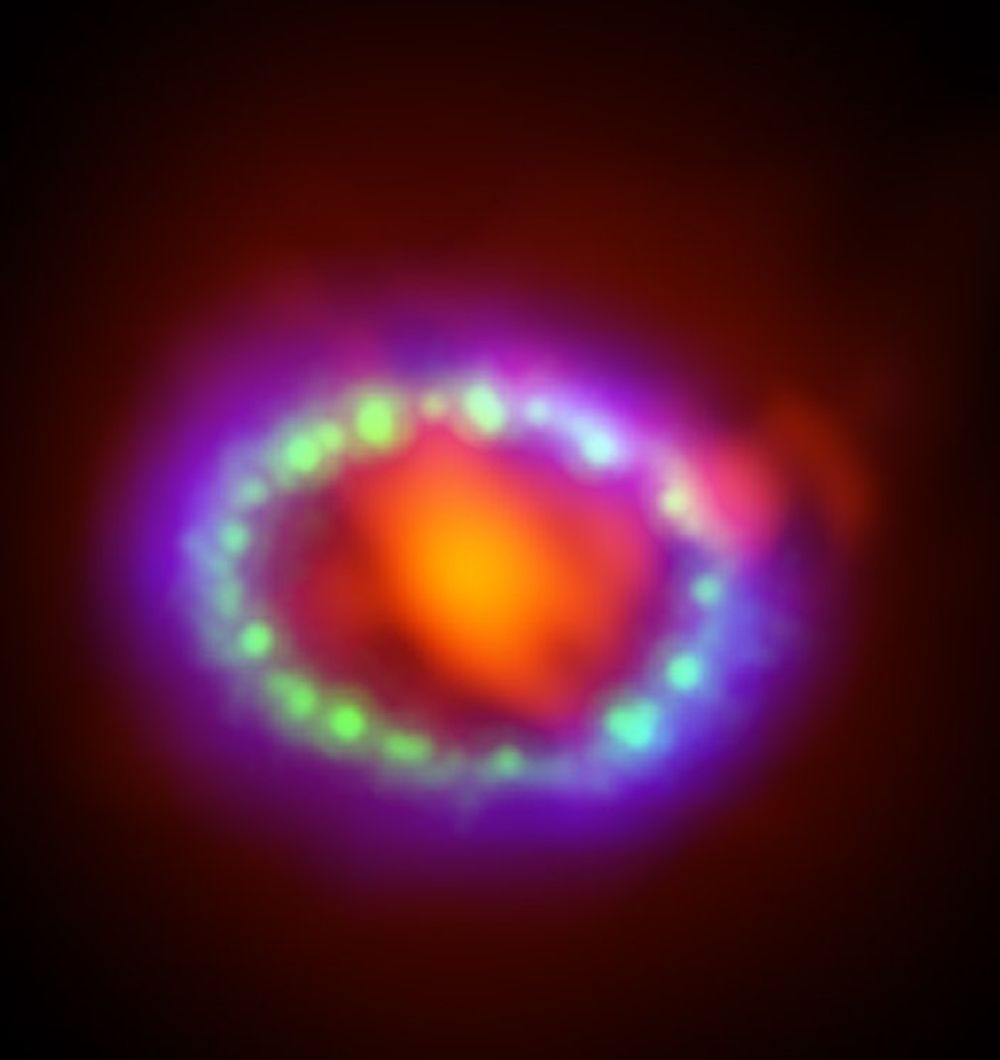
O site científico Scitechdaily publicou um artigo que fala de um novo modelo proposto para as Supernovas tipo IA . O tema é fascinante e se o modelo for confirmado esse tipo de Supenova pode não mais ser considerada uma vela padrão. O artigo original que traduzi e adaptei está aqui. http://scitechdaily.com/new-supernova-model-challenges-predominant-one/ O paper do estudo pode ser acessado aqui

Um estudo recém-publicado pelo Instituto de Astrofísica da Andaluzia descarta a possibilidade de que supernovas do tipo Ia possam ser resultado de explosões de anãs brancas alimentadas por estrelas normais. Se estas conclusões se generalizarem, supernovas do Tipo Ia poderão não servir mais como “velas padrão” (standard candles) para medir distâncias astronômicas.
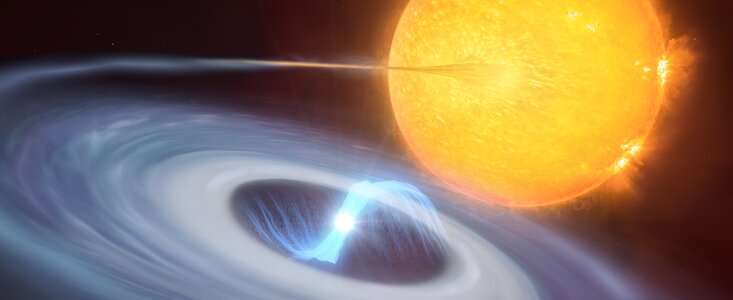
Supernovas do Tipo Ia acontecem quando uma anã branca, o “cadáver” de uma estrela parecida com o Sol, absorve material de uma estrela gêmea até que atinja uma massa crítica de 1,4 vezes a massa do Sol e exploda. Por causa de sua origem, todas estas explosões compartilham de uma luminosidade muito semelhante. Esta uniformidade fez das supernovas do Tipo Ia objetos ideais para medir distâncias no universo, mas o estudo da supernova 2014J sugere um cenário que as invalidaria como “velas padrão”.
“Supernovas Tipo Ia são consideradas velas padrão, pois sua constituição é muito homogênea e praticamente todas elas atingem a mesma luminosidade máxima. Elas ainda nos permitiram descobrir que o universo estava se expandindo a um ritmo acelerado. No entanto, nós ainda não sabemos que sistemas estelares dão origem a este tipo de supernovas “, diz Miguel Ángel Pérez Torres, pesquisador do Instituto de Astrofísica da Andaluzia (IAA-CSIC) encarregado do estudo.
Um novo modelo que postula a fusão de duas anãs brancas está agora desafiando o modelo predominante, composto por uma anã branca e uma estrela normal. O novo cenário não implica a existência de um limite máximo de massa e, portanto, não necessariamente produz explosões de luminosidade semelhante.

Os resultados mencionados acima foram obtidos a partir do estudo da supernova 2014J, situada a 11,4 milhões de anos-luz de distância do nosso planeta, usando as redes EVN e e MERLIN de radiotelescópios. “É um fenômeno que muito raramente ocorre em nosso universo imediato. 2014J é a supernova tipo IA mais próxima de nós desde 1986, quando os telescópios eram muito menos sensíveis, e pode muito bem ser a única que vai ser capaz de ser observada em tais vizinhanças nos próximos 150 anos “, diz Pérez Torres (IAA-CSIC).
A observação por Radio torna possível revelar que sistemas estelares estão por trás de supernovas tipo Ia. Se a explosão procede de uma anã branca que está sendo alimentada por uma estrela dupla, por exemplo, uma grande quantidade de gás deve estar presente no ambiente; Após a explosão, o material ejetado pela supernova irá colidir com este gás e produzir uma intensa emissão de raios X e ondas de rádio. Por outro lado, um par de anãs brancas não irá gerar este envelope gasoso e, por conseguinte, não haverá emissão de raios X, quer ou ondas de rádio.
“Nós não detectamos emissões de rádio em SN 2014J, o que favorece o segundo cenário”, diz Pérez Torres. “Se esses resultados ganharem aceitação geral, as consequências cosmológicas seriam de peso, porque o uso de supernovas do tipo Ia para medir distâncias seria questionada”, conclui o pesquisador.
Publicação:. MA Pérez-Torres, et al, “restrições no sistema progenitor e os arredores de SN 2014J a partir de observações de rádio profundas”, APJ, 2014, 792, 38; doi: 10.1088 / 0004-637X / 792/1/38


![When a black hole and a companion star orbit one another, the star's motion will change over time... [+] owing to the gravitational influence of the black hole, while matter from the star can accrete onto the black hole, resulting in X-ray and radio emissions. Recently, a 70 solar mass black hole was found fitting this scenario, the highest stellar mass black hole ever discovered like this. But this was a relief for astronomers, not a surprise!](https://thumbor.forbes.com/thumbor/960x0/https%3A%2F%2Fblogs-images.forbes.com%2Fstartswithabang%2Ffiles%2F2019%2F12%2FStellar-black-hole.jpg)
![While numerous black holes and even black hole pairs have been detected, we’d have to wait millions... [+] of years for any of the ones we've identified so far to actually merge.](https://thumbor.forbes.com/thumbor/960x0/https%3A%2F%2Fblogs-images.forbes.com%2Fstartswithabang%2Ffiles%2F2017%2F12%2FKennea-wide-still-labels.jpg)
![When a star approaches and then reaches the periapsis of its orbit around a stellar-mass or... [+] supermassive black hole, its gravitational redshift and its orbital speed both increase. If we can measure the appropriate effects of the orbiting star, we should be able to determine the properties of the central black hole, including its mass and whether it obeys the rules of special and general relativity.](https://thumbor.forbes.com/thumbor/960x0/https%3A%2F%2Fblogs-images.forbes.com%2Fstartswithabang%2Ffiles%2F2019%2F07%2Fstellar-color-v7-1200x861.jpg)
![X-ray emissions that are large, extended, and structure-rich highlight a variety of supernovae seen... [+] in the galaxy. Some of these are only a few hundred years old; others are many thousands. A complete absence of X-rays indicates the lack of a supernova. In the early Universe, this was the most common death-mechanism of the first stars.](https://thumbor.forbes.com/thumbor/960x0/https%3A%2F%2Fblogs-images.forbes.com%2Fstartswithabang%2Ffiles%2F2018%2F07%2FChandra-SN-Remnants-1200x735.jpg)
![Supernovae types as a function of initial star mass and initial content of elements heavier than... [+] Helium (metallicity). Note that the first stars occupy the bottom row of the chart, being metal-free, and that the black areas correspond to direct collapse black holes. For modern stars, we are uncertain as to whether the supernovae that create neutron stars are fundamentally the same or different than the ones that create black holes, and whether there is a 'mass gap' present between them in nature. At the high-mass end, black holes beyond a certain mass limit are constrained.](https://thumbor.forbes.com/thumbor/960x0/https%3A%2F%2Fblogs-images.forbes.com%2Fstartswithabang%2Ffiles%2F2018%2F09%2F1024px-Supernovae_as_initial_mass-metallicity.jpg)
![The visible/near-IR photos from Hubble show a massive star, about 25 times the mass of the Sun, that... [+] has winked out of existence, with no supernova or other explanation. Direct collapse is the only reasonable candidate explanation, and is one known way, in addition to supernovae or neutron star mergers, to form a black hole for the first time.](https://thumbor.forbes.com/thumbor/960x0/https%3A%2F%2Fblogs-images.forbes.com%2Fstartswithabang%2Ffiles%2F2017%2F12%2FPIA21467_hires-1200x800.jpg)
![The 11 events robustly detected by LIGO and Virgo during their first two data runs, spanning from... [+] 2015 to 2017. Note the larger the signal amplitudes (which correspond to higher masses), the shorter the signal duration (due to LIGO's frequency sensitivity range). The longest-duration signal, for binary neutron star mergers, is also the lowest-amplitude signal. As LIGO improves both its range and sensitivity (and lowers its noise floor), we expect this purported mass gap to get 'squeezed' from both the top and bottom.](https://thumbor.forbes.com/thumbor/960x0/https%3A%2F%2Fblogs-images.forbes.com%2Fstartswithabang%2Ffiles%2F2019%2F09%2FGW-catalogue-1200x684.jpg)
![The 11 gravitational wave events detected by LIGO and Virgo, with their names, mass parameters, and... [+] other essential information encoded in Table form. Note how many events came in the last month of the second run: when LIGO and Virgo were operating simultaneously.](https://thumbor.forbes.com/thumbor/960x0/https%3A%2F%2Fblogs-images.forbes.com%2Fstartswithabang%2Ffiles%2F2018%2F12%2FGW-detections.jpg)
![While practically all the stars in the night sky appear to be single points of light, many of them... [+] are multi-star systems, with approximately 50% of the stars we've seen bound up in multi-star systems. Castor is the system with the most stars within 25 parsecs: it is a sextuple system.](https://thumbor.forbes.com/thumbor/960x0/https%3A%2F%2Fblogs-images.forbes.com%2Fstartswithabang%2Ffiles%2F2018%2F04%2FCastor_sextuple-1200x511.jpg)
![Black holes are regions of space where there's so much mass in such a small volume that there exists... [+] an event horizon: a region from within which nothing, not even light, can escape. Yet this doesn't necessarily mean that black holes suck matter in; they simply gravitate, and can remain in stable binary, trinary, or even larger star systems just fine.](https://thumbor.forbes.com/thumbor/960x0/https%3A%2F%2Fblogs-images.forbes.com%2Fstartswithabang%2Ffiles%2F2017%2F12%2Fbhformation1080-e1489772414800-640x341.jpg)
![For the real black holes that exist or get created in our Universe, we can observe the radiation... [+] emitted by their surrounding matter, and the gravitational waves produced by the inspiral, merger, and ringdown. But just because we have yet to detect a merger within our own Milky Way doesn't mean they haven't occurred many times over the previous few million years, or over even longer timescales for that matter.](https://thumbor.forbes.com/thumbor/960x0/https%3A%2F%2Fblogs-images.forbes.com%2Fstartswithabang%2Ffiles%2F2017%2F06%2FBlackHoleArtZoomOut.medium.jpg)